The Highway to Homelessness:
How the Foster Care System Creates a 50% Risk of Instability

Imagine turning 18. For most young people, it’s a milestone of celebration, possibility, and emerging independence, cushioned by the support of family. But for thousands of youth across the country, their 18th birthday marks a cliff edge. On that day, the state—their legal parent—effectively wishes them luck and walks away. For far too many, the next step is onto the streets.

This is not hyperbole. According to the National Foster Youth Institute (NFYI), an estimated 20% of young people who age out of foster care become instantly homeless. The long-term picture is even more grim: nationwide, nearly 50% of the entire homeless population has spent time in the foster care system. This is not a tragic coincidence; it is a predictable, systemic outcome. The journey to homelessness for a former foster youth does not begin on their 18th birthday. It begins the moment they enter a system that, through its very structure of removal and instability, systematically dismantles the relational and emotional foundations a young person needs to build a stable adult life.

The Anatomy of a Pipeline: From Placement Instability to Street Instability

image for Article 1

The NFYI has aptly described the child welfare system as a "highway to homelessness" It is intended to be a temporary bridge to safety and permanency, but for a devastating number of children, it becomes a long, disjointed road of constant upheaval. The vehicle driving them down this highway is placement instability.

When a child is removed from their home, they experience an initial, profound trauma. As research from Casey Family Programs shows, this trauma often manifests in ways that are labeled as "behavior problems". A child acting out their fear, grief, and confusion can be difficult for even the most well-intentioned foster parents to manage. This can lead to a placement disruption—the child is moved to another new home, with new strangers, in a new neighborhood. Each move is a fresh trauma, a new broken attachment, and a devastating confirmation of the child's deepest fear: that they are unwanted, difficult, and alone.

The data on this is chilling. A 2024 study by Casey Family Programs found that children with clinically significant trauma symptoms have 46% higher odds of experiencing multiple placements. This cycle of disruption is not distributed equally; the same study found that Black youth had a 73% higher rate of placement instability compared to white peers compounding the trauma of separation with trauma of systemic inequity. Furthermore, youth placed in congregate care settings like group homes—often seen as a placement of last resort for "difficult" teens—are nearly twice as likely to experience homelessness after aging out.

Even these stark numbers likely understate the problem. Groundbreaking research from Chapin Hall at the University of Chicago, the "Voices of Youth Count" study, has highlighted the prevalence of hidden homelessness. This includes "couch surfing"—moving between homes of friends, relatives, or acquaintances—a precarious and often unsafe existence that doesn't show up in traditional shelter counts but is a common reality for youth who have exited the system. The problem is not just what we see; it's the vast, invisible crisis of instability that our system has created.

Aging Out: A System Designed for Failure

image for Article 1

The transition to adulthood is challenging for everyone. Young adults in their late teens and early twenties routinely rely on their families for financial help, emotional support, and a place to live during college breaks or after a job loss. A youth aging out of foster care has none of these safety nets. They have no one to co-sign a lease, no family to call in an emergency, no financial backstop when crisis hits.

The system's goal for these youth is "emancipation" or "independent living," but this concept is a dangerous fallacy.5 It mistakes the absence of state supervision for the presence of genuine self-sufficiency. We provide life skills classes and transitional housing programs, but these are bandages on the deep wound of relational poverty. True independence is not built on checklists; it is built on a foundation of interdependence and stable, loving relationships—the very things the foster care system dismantles.

Without this foundation, the interconnected challenges become overwhelming. Former foster youth experiencing homelessness are significantly more likely to become involved in the justice system; one study found 61% of homeless former foster youth had been incarcerated, compared to 46% of homeless youth who had never been in care. They are less likely to be employed or enrolled in school, creating a cycle of poverty and instability. Data from the National Youth in Transition Database confirms a direct link: youth who experience homelessness after age 17 are far less likely to be prepared for successful independent living across a range of metrics.16 We are setting them up to fail by expecting them to achieve a level of "independence" at 18 that we would never expect of our own children.

Building an Off-Ramp: Prevention Through Connection

The foster care-to-homelessness pipeline is a direct and predictable consequence of a system that prioritizes temporary placements over permanent connections. If we want to solve this crisis, we cannot wait until a young person is 17 and scrambling for housing. We must build an off-ramp from this highway, and that off-ramp is reinforcement.

At the Phoenix Parent Project, our philosophy is rooted in the understanding that the surest way to prevent an 18-year-old from aging out into homelessness is to prevent a 4-year-old from entering foster care in the first place. By providing families with the tools, resources, and support they need to heal and stay together, we prevent the initial trauma of removal and the subsequent cycle of placement instability that erodes a child's chance at a stable future.

For youth already in the system, reinforcement means a relentless, urgent pursuit of relational permanency. This is more than a legal status like adoption. It means ensuring that every single child has a lifelong, committed connection to at least one caring adult, whether that is a reunified parent, a relative, a mentor, or a former foster parent who commits to being family for life.

These are our children. When they enter foster care, we, as a society, become their parents. And for half of them, we are failing in our most basic duty: to provide a stable home. Preventing youth homelessness doesn't start with a shelter; it starts with a family. It starts with connection. It starts with reinforcement.

400,000 Children, 400,000 Stories:
Why a Number Can't Capture the True Cost of Foster Care

As the founder of the Phoenix Parent Project, I'm often asked what drives me. The answer begins with a number: 400,000. It's a statistic I carry with me every day, a constant reminder of the scale of the crisis we face. On any given day in the United States, hundreds of thousands of children are living in the foster care system, separated from their parents and everything they’ve ever known. The most recent data from the federal government’s Adoption and Foster Care Analysis and Reporting System (AFCARS) shows the number of children in care on a single day in FY 2023 was 343,077, a slight decrease but still a population the size of a major American city like Cleveland or New Orleans.

This number, while staggering, is a flat, one-dimensional metric. It tells us the "what" but not the "who," the "why," or, most importantly, the "what next." It papers over a landscape of profound inequity and systemic failure. To truly understand the crisis of family separation, we must look behind this number. We must deconstruct it to reveal the human stories, the institutional biases, and the devastating, often hidden, costs of a system that, in its very design, can become the primary source of a child's trauma. The 400,000 figure isn't just a count of children in need; it's an indictment of a paradigm that has for too long chosen removal over reinforcement.

Deconstructing the 400,000: A System of Disproportionality

To understand who these children are, we turn to AFCARS, the federally mandated data collection system that provides our most comprehensive, though imperfect, national picture of the child welfare system. And when we look closely at that data, a disturbing pattern emerges immediately: the system’s intervention is not applied evenly.

image for Article 2

While White children make up the largest raw number of children in care, Black and American Indian/Alaska Native (AI/AN) children are represented at rates that far exceed their proportion of the general child population. According to the FY 2022 AFCARS data, Black or African American children, who represent about 14% of the total U.S. child population, accounted for 21% of all children entering foster care that year. The following year, they made up 21% of all children waiting to be adopted. The disproportionality for Native children is just as stark. American Indian/Alaska Native children comprise about 1% of the national child population but represent 2% of children in the foster care system—double their share.

Race/Ethnicity Approx. % of U.S. Child Population % of Children Entering Foster Care (FY 2022)
White 50% 43%
Black or African American 14% 21%
Hispanic 26% 22%
American Indian/Alaska Native 1% 2%
Two or More Races 5% 8%

This is not a statistical anomaly; it is evidence of a deep and persistent systemic bias. The decision to remove a child is one of the most consequential a state can make, and this data shows that the burden of that intervention falls disproportionately on families of color. This reality is not lost on the federal government. Recent proposed changes to the AFCARS reporting requirements, specifically to better track compliance with the Indian Child Welfare Act of 1978 (ICWA), are a direct acknowledgment of the system's historic and ongoing failure to protect Native families.6 The federal rule itself notes that AI/AN children in state foster care have experienced a "separation and disconnection from their community, culture, and language," leading to devastating outcomes.6

This brings us to a crucial understanding. The 400,000 statistic is not simply a measure of child endangerment; it is a barometer of racial injustice. For countless families of color, the child welfare system does not feel like a source of support but like another arm of a state that has historically policed, surveilled, and marginalized their communities. The "unseen wound" of family separation is therefore compounded by the deep, historical wound of systemic bias. We cannot claim to be protecting children if the very system we use to do so perpetuates the same inequities that make their families vulnerable in the first place.

The Illusion of Rescue: When Removal Is the Trauma

image for Article 2

The stated primary goal for most children who enter foster care is to eventually return home. In FY 2022, the case plan goal for 52% of children was reunification with their parents or primary caretakers.5 Yet, in that same year, only 46% of children who exited the system were actually reunified.5 This gap between intent and outcome points to a fundamental flaw in the system’s logic. It operates under the premise that removing a child is a necessary step toward healing the family, but it fails to account for a critical fact: the removal itself is a deeply traumatic event.

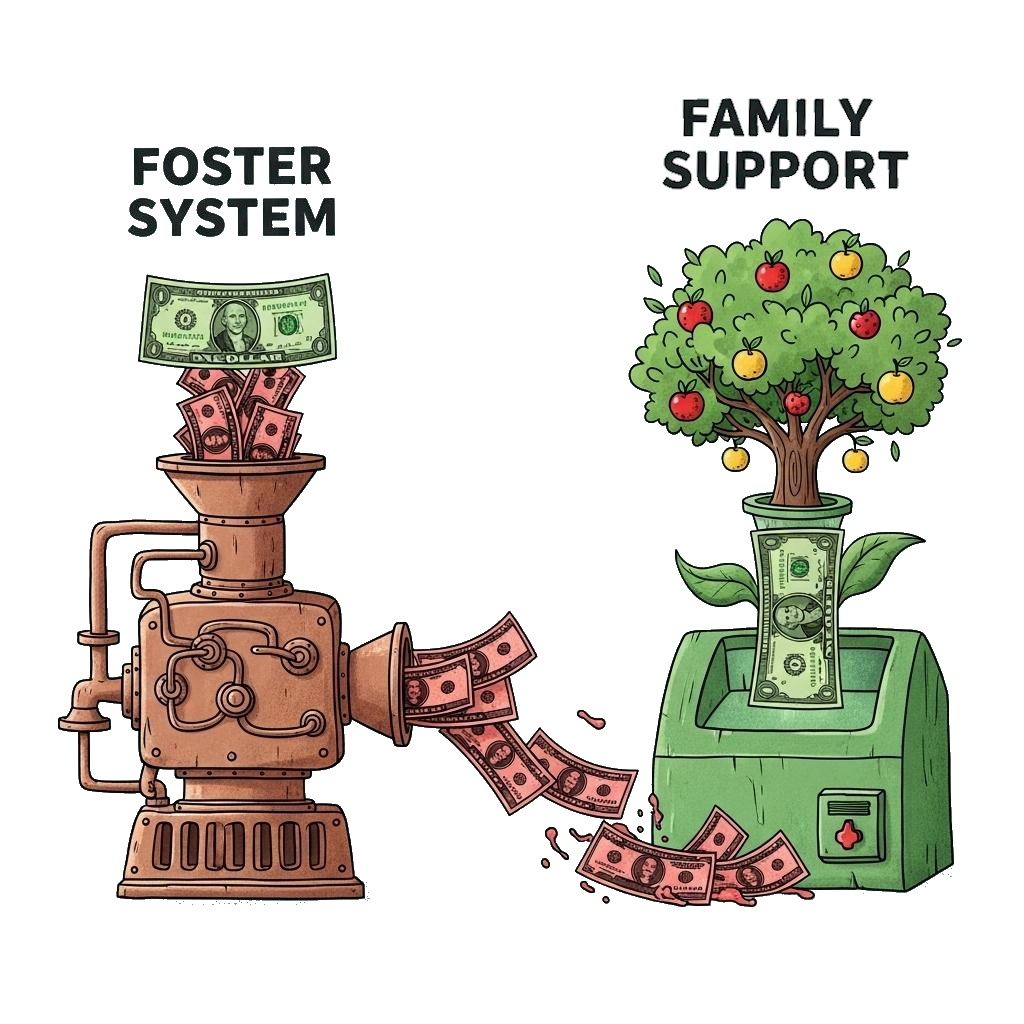
This reveals the system's foundational paradox. Its primary tool, removal, is justified as a necessary act to ensure a child's safety and well-being. Yet, a significant body of evidence demonstrates that this very act is iatrogenic—a treatment that causes its own harm. This harmful intervention is also fiscally irresponsible. The average cost to keep a single child in foster care is over $25,000 per year, a figure that covers housing, case management, and administrative overhead.9 In contrast, the preventative services that could avert the trauma of removal often address simple crises of poverty and cost a fraction of that amount—less than $500 to cover a past-due utility bill or secure a safe crib for a newborn.9

We are spending billions of dollars on a "solution" that we know causes profound psychological damage and is often less effective than leaving a child in their home. This is not a failure of individual caseworkers, who are often dedicated professionals working in an impossible system. It is a failure of the entire paradigm. The number 400,000, therefore, represents not just children in need of protection, but hundreds of thousands of children subjected to a traumatic, expensive, and demonstrably ineffective state intervention every year.

Research from Casey Family Programs, a leading voice in child welfare, is unequivocal on this point: the processes of investigation, removal, and placement are "in and of themselves traumatic events for children and families".8 The trauma of being separated from a parent can, as the American Bar Association has noted, "far outweigh the alleged harm that led to the separation in the first place".9 This is especially true in the so-called "marginal cases," where the maltreatment is not severe. In these situations, research suggests that children who are removed and placed in foster care actually have worse long-term outcomes—including higher rates of delinquency, teen pregnancy, and lower adult earnings—than similarly situated children who are left in their homes with support.

A Better Way: From Removal to Reinforcement

The data paints a clear and damning picture: our current approach to child welfare is broken. It is disproportionately punitive toward families of color, and its core intervention creates a new layer of trauma that harms children's long-term prospects. We cannot continue down this path.

This is why I founded the Phoenix Parent Project. As I’ve said before, "We must shift our focus from a paradigm of removal to one of reinforcement." This isn't a call for a softer or less rigorous approach. It is a call for a smarter, more humane, and ultimately more effective one. Reinforcement means proactively addressing the root causes of family instability—poverty, housing insecurity, lack of social support, and unaddressed parental trauma—before they escalate into a crisis that triggers a child protection response.

The evidence for this approach is overwhelming, both morally and economically. A recent analysis from Chapin Hall at the University of Chicago found that an additional $1,000 in cash assistance to families living in poverty is associated with a 2.1% decline in foster care placements. A comprehensive study by the RAND Corporation concluded that a policy package combining preventative services with support for kinship caregivers could save the child welfare system between $5.2 billion and $10.5 billion for a single five-year cohort of children.12

Investing in families is not only the right thing to do; it is the most fiscally responsible thing to do. The question is not whether we can afford to support families in staying together. The data shows, unequivocally, that the real question is whether we can afford not to. The hundreds of thousands of children behind that single, stark number are waiting for our answer. It is time we gave them a new one—one built not on separation, but on the enduring power of family.


A Wound We Can't See:
Why Foster Care Childrens’ PTSD Rates Double War Veterans

When we think of Post-Traumatic Stress Disorder (PTSD), we often picture a soldier returning from a foreign battlefield. It's a valid and vital image of sacrifice and psychic injury. But I want you to hold a different image in your mind: a child. A seven-year-old girl being placed in the back of a caseworker's car, her hand pressed against the window as she watches her home, her parents, her entire world shrink in the rearview mirror. This child is also a veteran. She is a veteran of a war fought not in a distant land, but within her own home and the very systems designed to protect her. And her wounds are just as real.

In fact, the evidence suggests they may be even more prevalent. According to a landmark study by Casey Family Programs, children who have been in foster care experience PTSD at a staggering rate of 21.5%. To put that in perspective, this rate is more than double the rates found in U.S. war veterans from Iraq (12-13%) and Afghanistan (6%).

The Neurobiology of a Broken Bond

The trauma experienced by children in the system is not typically a single, isolated event. It is chronic, complex, and, most importantly, relational. It begins with the terror and confusion of the initial removal, which is then compounded by the profound uncertainty of what comes next, the loss of all control, and the high potential for multiple placements with strangers, each one a new rupture

image for Article 3

To understand why this is so damaging, we have to understand the basics of brain science. A child's brain is biologically wired for attachment to a primary caregiver. This bond is the fundamental organizing principle of their development; it is the source of their safety, their ability to regulate their emotions, and their budding sense of self. When that bond is forcibly severed by the state, it triggers a massive physiological stress response. Researchers describe this as "toxic stress," an experience so intense that it can lead to lasting "neurobiological and epigenetic alterations". Studies have shown that institutionalized care can result in reduced brain activity in the very regions responsible for problem-solving, communication, and social skills. This isn't just about a child feeling sad or scared; it is a physiological injury to the developing architecture of their mind.

This raises a difficult but essential question: why is this experience so psychologically devastating, even more so by prevalence than combat? The answer lies in the nature of the trauma. For a soldier, the trauma is horrific, but it is typically inflicted by a clear enemy. For a child removed from their home, the trauma is inflicted by the very people and systems that are supposed to be their source of safety and protection. This creates a profound betrayal trauma, shattering the child's fundamental belief that the world is a safe place and that adults can be trusted. There is no "safe base" to return to.

Furthermore, the trauma is developmental. It occurs while the brain's core structures are still being formed, disrupting the very foundation of the child's capacity for future relationships, emotional regulation, and resilience. Unlike a soldier who goes to war as an adult with a more-or-less formed identity, the child's identity is being forged *by* the trauma. This is why the PTSD rate is so high and the psychological injury so deep and persistent.

The Lifelong Cost of an Unseen Wound

image for Article 3

This epidemic of PTSD is not an isolated mental health issue. It is the engine driving the cascade of negative outcomes we see for foster care alumni throughout their lives. The Casey National Alumni Study explicitly links the high prevalence of mental health disorders to "difficulty gaining or maintaining employment and to poor educational outcomes". The trauma manifests as the placement instability that leads directly to the homelessness crisis we've discussed. It fuels the high rates of substance abuse, as alumni struggle to self-medicate their invisible wounds; the Casey study found rates of drug dependence over seven times higher and alcohol dependence nearly two times higher than in the general population.

Mental Health Condition Prevalence in Foster Care Alumni (%) Prevalence in General Population (%)
Post-Traumatic Stress Disorder (PTSD) 21.5% 4.5%
Major Depressive Episode 15.3% 9.4%
Panic Disorder 11.9% 3.6%
Drug Dependence 8.9% 0.5%
Alcohol Dependence 10.6% 5.1%

This widespread psychological distress carries an enormous economic cost. A recent analysis calculated that for a child with a complex foster care history, the long-term societal costs of negative outcomes—including healthcare, justice system involvement, and lost productivity—can exceed $627,000. This represents a catastrophic negative return on investment for the public. In stark contrast, preventative services that support families are remarkably cost-effective. A landmark RAND study found that a comprehensive policy package combining prevention and kinship support not only improves child well-being but also pays for itself, potentially saving the public billions of dollars

The Only Trauma-Informed Approach is Prevention

The 2-to-1 PTSD rate is the ultimate verdict on the paradigm of removal. It represents a catastrophic failure of public health. A system cannot claim to be acting in the interest of "child welfare" if its primary intervention is a known cause of severe, long-term psychological trauma.

A truly trauma-informed system does not simply ask, "How can we make the act of removal less traumatic?" It must ask the more fundamental question: "How can we avoid the trauma of removal altogether?" This is the core of the reinforcement model we champion at the Phoenix Parent Project. It is about investing in healing families so they can be the source of safety, stability, and love that every child needs, rather than replacing them with a state system that we know, with scientific certainty, causes profound harm.

We cannot continue to send children into a system that wounds them so deeply and then act surprised when they struggle to heal. The most compassionate, the most effective, and the most fiscally responsible thing we can do is to help families find the strength to rise from the ashes of their own struggles, together. That is the work of the Phoenix Parent Project. Join us.

The Economics of Empathy:
Calculating the True ROI of Keeping a Family Together

In the world of child welfare, there is a persistent and damaging myth: that keeping families together is a "soft," idealistic, and expensive goal, while removing a child is the tough but fiscally responsible choice. This could not be more wrong. As the founder of a data-driven organization, I am here to tell you that the cold, hard numbers lead to an inescapable conclusion: empathy has a better return on investment than punishment. Investing in reinforcing families is not just our moral imperative; it is the single most fiscally prudent strategy we can pursue.

For decades, we have poured billions of dollars into a foster care system that, by any objective financial measure, is a catastrophic failure. We must stop thinking of family preservation as an expense and start seeing it for what it is: a high-yield social investment with a clear and compelling return.

The Negative ROI of the Status Quo

Let’s start with the cost of our current approach. When a child enters foster care, the state incurs direct costs for their placement, case management, and administrative overhead, averaging over $25,000 per child, per year. But these upfront costs are just the tip of the iceberg. The real financial damage comes from the devastating long-term consequences of this traumatic intervention.

image for Article 4

A groundbreaking analysis by Chapin Hall at the University of Chicago calculated the Social Return on Investment (SROI) for foster care. The findings are staggering.

Empirical / Concrete Figures:

  • For a child in a "best-case" scenario (e.g., a short stay, successful reunification), the long-term societal costs from negative outcomes like lost earnings, crime, and increased welfare dependency result in an SROI of -$3.64. For every dollar we invest, we lose $3.64.
  • For a child in a more typical, complex scenario (e.g., multiple placements, aging out), the SROI plummets to -$9.55. For every dollar we invest, we generate nearly ten dollars in future societal costs.

These are not just abstract numbers. They represent the lifetime cost to taxpayers for increased incarceration, homelessness, mental and physical health crises, and lost economic productivity—all direct consequences of a system that fails to provide stability. The lifetime societal cost for a single youth who ages out of the system can be as high as $627,000. The total economic burden of child maltreatment in the U.S. has been estimated at a staggering $80 billion per year.

To put it bluntly, we are paying an absolutely staggering price for a system that — (thanks to rigorous studies and subsequent analyses of the fiscal innerworkings powering various moving parts of the industry) — we now know causes harm. Let me ensure I’m clear with regards to this last point by affirming that unlike the findings and views held by the majority of the scientific community 30 years ago, technological advancements (alongside increased focus on this area of study by society in general) has provided concrete evidence that almost erases this point as being one of contention.

The Positive ROI of Prevention

Now, let's compare that to the economics of empathy—the cost of proactively investing in families to prevent the need for removal. The data here is just as clear, but it tells a story of remarkable returns.

Intervention Cost Return on Investment (ROI)
Crisis Aversion < $500 (e.g., to pay a utility bill or rent) Avoids the $25,000+ annual cost of foster care.
Cash Assistance $1,000 direct payment to a family in poverty Reduces foster care placements by 2.1%.
Supportive Housing Varies Saves child welfare systems an average of $14,600 per family over 5 years.
Evidence-Based Therapies (like PCIT) ~$1,000 - $2,000 per family Every successfully treated child saves society up to $2 million in averted lifetime costs (crime dropout, etc.). One analysis shows a benefit-to-cost ratio of $17.46 for every dollar spent.
image for Article 4

This is the core of the economic argument. We can spend $25,000 on a foster care placement that generates a negative return of -$9.55 for every dollar, or we can spend a fraction of that amount on preventative services that not only keep a family together but also generate massive downstream savings.

A comprehensive RAND Corporation study modeled this out on a national scale. It found that a policy package combining expanded prevention services with support for kinship caregivers would create a net cost *reduction* for the public, saving between $5.2 billion and $10.5 billion for a single five-year cohort of children. Investing in families literally pays for itself.

The choice we face is a simple one. We can continue to fund a broken, trauma-inducing system that drains public resources and destroys human potential. Or, we can embrace the economics of empathy. We can shift our resources upstream to provide the housing support, cash assistance, and mental health services that we know prevent family separation. This is the mission of the Phoenix Parent Project. We are not just advocating for a more compassionate approach; we are championing a smarter, more strategic, and ultimately more profitable investment in our collective future.

The PCIT Revolution: Parent-Child Interaction Therapy
Rewiring Attachment Bonds Before They Break

In my work, I’ve spoken at length about the invisible wounds of family separation—the trauma that rewires a child’s brain and the staggering rates of PTSD that follow. For too long, the conversation in child welfare has been focused on diagnosing the problem. Today, I want to talk about a solution. I want to talk about a revolution in healing that is quiet, methodical, and happening right now in therapy rooms across the country. It’s called Parent-Child Interaction Therapy, or PCIT, and it is one of the most powerful, evidence-based tools we have to prevent the trauma of removal before it happens.

PCIT is not your typical talk therapy. It is a hands-on, real-time coaching program for parents and their young children (typically ages 2-7) who are struggling with challenging behaviors. It is designed to do two things with remarkable efficiency: rebuild a warm, secure attachment between parent and child, and give parents the concrete skills to manage difficult behaviors with confidence and calm. It is the very definition of reinforcement, and it offers a clear, scientifically-backed path away from the destructive cycle of conflict and removal.

How It Works: Coaching, Not Criticism

The magic of PCIT lies in its elegant, two-phase structure and its unique coaching method. The parent and child are in a playroom, while a therapist observes from another room through a one-way mirror or a video feed. The parent wears a small earpiece—a "bug-in-the-ear"—and the therapist provides live, in-the-moment coaching. This method is transformative because it moves away from theoretical advice and provides immediate, practical guidance as interactions unfold.

image for Article 5

Phase 1: Child-Directed Interaction (CDI). The first goal is to rebuild the foundation of the relationship: warmth, security, and positive connection. The therapist coaches the parent to use a set of skills known by the acronm

‘PRIDE’ - Praise, Reflection, Imitation, Description, Enjoyment

  • Praise: Acknowledging and encouraging positive behavior.
  • Reflection: Repeating what the child says to show they are being heard.
  • Imitation: Engaging in the child’s play to build rapport.
  • Description: Narrating what the child is doing — shows interest, helps build vocabulary.
  • Enjoyment: Expressing genuine enthusiasm and fun.

In this phase, the parent learns to follow the child's lead, showering them with positive attention and rebuilding the emotional bond. For families under stress, where interactions have become defined by conflict, this phase is a revelation. It systematically replaces negative patterns with positive ones, helping the child feel safe, secure, and valued.

Phase 2: Parent-Directed Interaction (PDI). Once the positive foundation is set, the focus shifts to discipline. The therapist coaches the parent in proven techniques for managing challenging behaviors, such as giving clear, effective commands and using consistent, calm consequences like a time-out procedure. The parent learns to set firm limits while maintaining the warmth and connection established in the first phase. This empowers the parent to de-escalate situations and guide their child’s behavior without resorting to yelling or harsh punishment, which often fuels the cycle of defiance.

A Proven Tool for Healing and Stability

PCIT is not a hopeful theory; it is a rigorously tested, evidence-based intervention. Study after study has shown that it leads to significant reductions in tantrums, aggression, and defiance, while increasing a child's self-esteem and pro-social behaviors. It is effective for children with a range of challenges, including ADHD, oppositional defiant disorder, and anxiety.

image for Article 5

Crucially, PCIT directly addresses the core risk factors for foster care placement. Research from Casey Family Programs identifies interventions like PCIT as critical for enhancing secure attachment and decreasing the behavioral problems that can lead to placement disruption. When parents are equipped with these skills, they are less likely to feel overwhelmed, and the family environment becomes more stable and predictable. This is prevention in its purest form.

The Phoenix Parent Project is meticulously designed, developed, and deployed as a means of championing a paradigm shift from removal to reinforcement. PCIT is what that reinforcement looks like in practice. It is a tangible, skill-based program that honors the parent-child bond as the central pillar of a child's well-being. It doesn’t see parents as the problem; it sees them as the solution, needing only the right tools and support to heal their family. The trauma of family separation is a deep and complex wound, but with revolutionary tools like PCIT, we are proving, one family at a time, that it is a wound we can heal.

Neglect by Numbers:
How the System Confuses Poverty with Parental Failure

There is a word in the child welfare lexicon that is both the most common reason for a family to be torn apart and the most dangerously misunderstood: neglect. It accounts for the overwhelming majority of child maltreatment cases—nearly three-quarters of all substantiated reports—and yet its definition is often a murky catch-all for circumstances that have far more to do with a family’s tax bracket than their capacity to love.

What does neglect look like? The statutes often define it as the failure to provide adequate food, clothing, shelter, or medical care. To a caseworker standing in a sparsely furnished apartment, an empty refrigerator or a pile of unpaid bills can look like a parental deficit. But to the parent, it looks like the impossible choice between paying the rent and buying groceries, between keeping the lights on and affording a doctor’s visit. What the system labels as neglect is, in far too many cases, simply the daily, grinding reality of poverty.

The Criminalization of Scarcity

The conflation of poverty and neglect is so pervasive that over half of U.S. states have had to explicitly write statutory exclusions clarifying that a child cannot be removed from their home solely due to poverty. The very need for such laws is a stunning admission of the system's inherent bias. For families navigating the treacherous landscape of low wages and housing insecurity, the child welfare system often feels less like a source of support and more like an arm of law enforcement, surveilling their lives and scrutinizing their every struggle.

image for Article 1

This process creates what I call the "criminalization of scarcity." When a parent cannot afford childcare, leaving an older child to supervise a younger one can be labeled supervisory neglect. When a family cannot afford a car repair, missed doctor's appointments can become medical neglect. When a family faces eviction, housing instability itself becomes a justification for removal. These are not failures of character; they are failures of a society that has allowed the social safety net to fray to the point of breaking.

Instead of providing resources, we provide investigations. Instead of offering support, we threaten separation. This approach is not only cruel, it is profoundly counterproductive. The Family Stress Model, a well-established theory in developmental psychology, shows that economic hardship creates immense psychological pressure on parents, which can disrupt parenting and family stability. By responding to this stress with the punitive threat of removal, the system exacerbates the very instability it claims to be solving. It pours gasoline on a fire and then blames the family for the blaze.

The Cure for Neglect Isn't Removal, It's Resources

If we accept the data—that the vast majority of neglect cases are inextricably linked to poverty—then the solution becomes blindingly obvious. The most effective, humane, and just form of child protection is not found in the pervasive and often traumatic cycles of surveillance and child removal from their families. Instead, it lies in a fundamentally different approach: the proactive provision of concrete economic support directly to families in need.

This paradigm shift acknowledges that economic hardship is a primary driver of neglect, rather than a lack of parental care or intent. When families struggle to meet basic needs such such as food, shelter, and healthcare due to insufficient income, the symptoms of that struggle can manifest as neglect, even when parents are doing their absolute best. By addressing the root cause—poverty—we empower families to create stable and nurturing environments for their children. This could include initiatives such as universal basic income, expanded child tax credits, affordable housing programs, accessible healthcare, and robust food assistance. Such measures not only alleviate immediate financial strain but also foster a sense of security and well-being that allows parents to focus on their children's development without the constant pressure of survival. Ultimately, investing in economic support for families is an investment in the well-being and future of our children, creating a more just and equitable society for all.

 image for Article 6

The evidence for this is overwhelming and irrefutable. A landmark analysis from Chapin Hall at the University of Chicago found that for every additional $1,000 in cash assistance provided to families living in poverty, foster care placements decline by 2.1%. Another study found that a 10% increase in state public benefits was associated with an 8% reduction in foster care placements. These are not small correlations; they are powerful causal links. When you give families the resources to meet their basic needs, the "neglect" often vanishes, because it was never a true deficit of care in the first place.

This is the principle of reinforcement in action. It means shifting our focus and our funding from a reactive, punitive system to a proactive, supportive one. It costs the state, on average, over $25,000 a year to place a single child in foster care. Yet, the crisis that triggered the removal could often have been averted for less than $500—the cost of a past-due utility bill, a car repair, or a safe crib. Providing supportive housing has been shown to save child welfare agencies an average of $14,600 per family over five years by preventing the need for out-of-home placements.

Shifting Gears, Moving Forward

image for Article 6

The curriculum of the Phoenix Parent Project aims to blatantly expose the systemic tendency for social services to (intentionally or not) mistake the symptoms of poverty for the signs of parental failure. It is time to stop punishing families for being poor. A family that lacks resources does not need judgment; it needs support. A parent struggling to make ends meet does not need a caseworker threatening to take their child; they need a hand up to secure housing, food, and stability. The most powerful tool for child protection isn't a court order; it's a grocery card, a rent check, and a community that chooses to invest in its families rather than tear them apart.